For mental health counselors and psychotherapists, the therapeutic relationship includes every interaction the client has with the practice, including those that happen outside the therapy session. Clients experience billing or administrative issues as part of that relationship.
A confusing invoice.
A limited number of sessions with no explanation why.
An unexplained deductible bill.
A surprise balance months after a session.
These moments can quietly undo the trust that clinical work spends months building.
SteadyStream Billing provides insurance billing services for private practice therapists and small mental health practices. We don't communicate directly with clients; our work happens behind the scenes so clinicians can stay focused on care. Trauma-informed principles still apply to what we do, though. Our responsibility is to make sure the systems, policies, and resources we provide support a trauma-informed client experience, even when we're rarely the ones in the room with the client.
A trauma-informed approach to finances matters to us personally. While we’ve experienced financial instability firsthand, I’ve also spent years delivering difficult financial news to people already under stress while working at a bank after the 2008 financial crisis. So I've seen up close how much anguish surprise bills and financial uncertainty can cause. That experience shaped our decision to build SteadyStream Billing around transparency and reducing surprises because we believe clients deserve that consideration from everyone involved in their care, including the billing side they rarely see.
Our trauma-informed approach shows up in three ways:
the insurance billing work we do on a practice's behalf,
the educational resources we publish so therapists can explain insurance to their clients with confidence,
and the internal policies and procedures we hold ourselves to as a company.
Why Mental Health Billing Deserves a Trauma-Informed Approach
Money is rarely just money in a therapeutic context. For many clients, financial confusion can surface the same feelings of powerlessness, distrust, or shame that show up elsewhere in their healing process. A missed explanation of benefits or an unexpected charge can feel like a breach of the safety a client has worked hard to build with the clinician, even though it started as an administrative issue.
The Substance Abuse and Mental Health Services Administration (SAMHSA) outlines six guiding principles for a trauma-informed approach:
safety,
trustworthiness and transparency,
peer support,
collaboration and mutuality,
empowerment and choice, and
responsiveness to cultural, historical, and gender issues (SAMHSA, 2014).
SAMHSA designed these principles for clinical and organizational settings. We've built SteadyStream Billing around the belief that they apply just as directly to the billing infrastructure behind a therapy practice.
Below is how each principle shapes our policies, our billing work, and the resources we publish for therapists and clients.
1. Safety
Clients shouldn’t experience a bill as a threat to their care, even if they never hear from us directly (SAMHSA, 2014). Accuracy and timeliness matter for this reason. That’s why we submit claims biweekly with consistency and attention to detail, verify benefits proactively before the first session, and flag and follow up on administrative issues like unpaid claim balances. We built our internal procedures to try to catch these issues before they ever reach the therapy room.
2. Trustworthiness & Transparency
Trust is built when people understand what's happening and why (SAMHSA, 2014). Since we aren't in direct contact with clients, our role in transparency is to equip therapists to have these conversations well. We give practices clear, accurate benefit and claims information they can pass along to clients, and we publish blog content that breaks down confusing insurance concepts like deductibles, copays, EOBs, and authorizations in plain language therapists can share directly with clients or point them to.
3. Peer Support
Insurance terminology isn't intuitive. Clients who ask "What's an Explanation of Benefits?" are asking a completely reasonable question about a genuinely confusing system rather than failing to pay attention. Our educational resources exist so therapists don't have to become insurance experts themselves. They can lean on our blog and guidance to normalize these questions for clients and answer them with confidence.
4. Collaboration & Mutuality
High-quality care depends on a strong partnership between clinical and administrative functions (SAMHSA, 2014). We see ourselves as a collaborator with each practice we work with rather than a separate, disconnected vendor. Clear communication with the practice about claims status, prompt resolution of issues, and billing procedures that are easy for therapists to understand and explain to their clients all follow from that view.
5. Empowerment, Voice & Choice
We believe clients do best when they're active participants in understanding their own care (SAMHSA, 2014). Since we can't have that conversation with clients directly, we invest in giving therapists the tools to have it well. Clear explanations of coverage and cost, educational content clients can be pointed to, and accurate information delivered early all help clients and clinicians make informed decisions together instead of reacting to a surprise after the fact.
6. Cultural, Historical & Gender Responsiveness
Comfort with financial conversations, trust in institutions, and access to insurance literacy vary widely across different backgrounds and life experiences (SAMHSA, 2014). Our blog and educational materials are written in plain, accessible language. Our internal policies are also built with the awareness that the practices we serve work with a wide range of clients, so the information we provide needs to be usable and respectful for all of them, particularly clients who are least comfortable navigating insurance systems already.
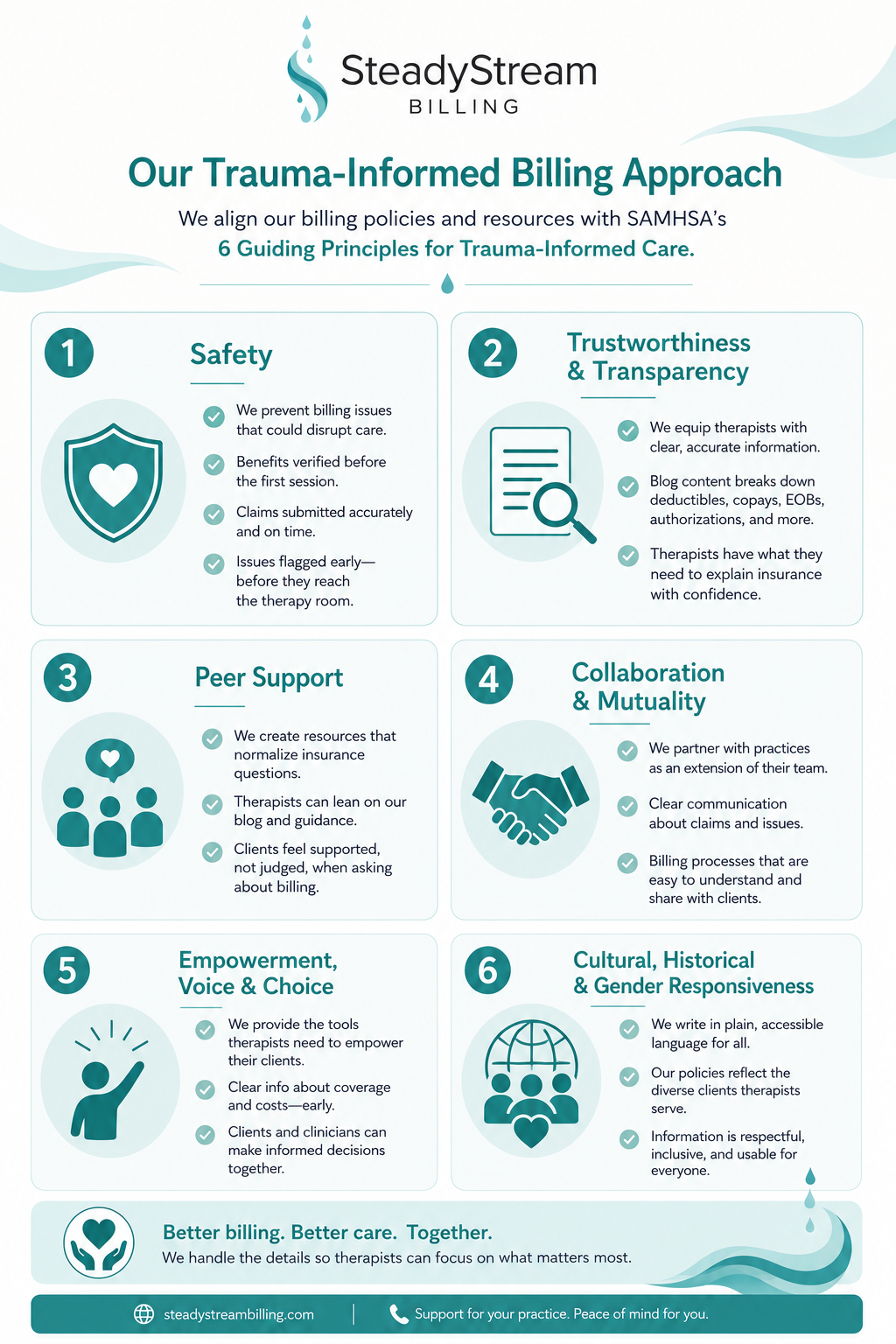
6 Principles of Trauma-Informed Billing
Image courtesy of ChatGPT (OpenAI, 2026).
Why Financial and Insurance Stress Deserves Sensitivity
The trauma-informed framing reflects a growing body of research on how financial strain and the burden of navigating health insurance affect mental health. Medical debt in particular has been linked to worse mental health outcomes and reduced access to care. In a nationally representative study using 2022 National Health Interview Survey data, adults with current depression who carried medical debt were more than twice as likely to delay mental health treatment, and adults with current anxiety and medical debt showed a similar pattern. The same study found that medical debt was associated with people forgoing mental health care altogether, suggesting a cycle in which financial strain both results from and worsens psychological distress (Moon et al., 2024).
This pattern extends beyond debt that has already accumulated; the stress of financial uncertainty, including confusion about bills and coverage, appears to matter independently. A systematic review of debt and mental health outcomes in the U.S. found that unpredictable, opaque financial obligations, a category that definitely includes medical costs, were consistently associated with higher anxiety, depression, and even suicidality, partly because of the diminished sense of control people experience when navigating these systems.
Medical debt stood out from other debt types in the review because it typically arises unexpectedly, and the underlying costs are often difficult to understand in advance, affecting even people who are otherwise financially stable (Rooney et al., 2026). Younger adults appear especially vulnerable to this dynamic: in a study of U.S. adults aged 18 to 26, those in the highest quartile of financial stress had over six times the odds of high psychological distress compared to those with the lowest financial stress, reporting symptoms including sadness, nervousness, restlessness, and hopelessness (Nasir et al., 2025).
This distress often translates into avoidance behaviors that directly interfere with care. Survey data from a national medical debt relief organization found that people carrying medical debt commonly report avoiding calls from providers and avoiding their mail altogether, and more than half had deferred further medical care specifically because of medical debt (Undue Medical Debt, 2025).
Takeaways SteadyStream Billing Applies
Taken together, this research supports what trauma-informed principles would predict. Financial uncertainty and navigating insurance are active stressors capable of worsening symptoms and discouraging help-seeking, and left unaddressed, they can undermine the treatment clients are trying to access. The accuracy, clarity, and timeliness of the billing infrastructure behind a practice carry real clinical weight, even though that work happens outside the therapy room.
A therapist who has accurate, timely billing information and clear educational resources can have calm, confident financial conversations with clients rather than confused or defensive ones. A practice with clean internal billing procedures also avoids interrupting a client's care over a preventable administrative gap. The values we hold as a billing company are inseparable from the values therapists are trying to uphold in the session.
Insurance literacy matters well beyond getting bills paid, shaping access, continuity, and equity. When therapists are equipped to explain insurance clearly, clients can make informed decisions about their care. Policies, procedures, and resources that support a trauma-informed client experience, even from behind the scenes, are the standard we hold ourselves to at SteadyStream Billing.
References
Moon, K. J., Linton, S. L., & Mojtabai, R. (2024). Medical debt and the mental health treatment gap among US adults. JAMA Psychiatry, 81(10), 985–992. https://doi.org/10.1001/jamapsychiatry.2024.1861
Nasir, A., Javed, U., Hagan, K., Chang, R., Kundi, H., Amin, Z., Butt, S., Al-Kindi, S., & Javed, Z. (2025, January 6). Social determinants of financial stress and association with psychological distress among young adults 18–26 years in the United States. Frontiers in Public Health, 12, Article 1485513. https://doi.org/10.3389/fpubh.2024.1485513
OpenAI. (2026). ChatGPT (July 23 version) [Large language model]. https://chat.openai.com/chat
Rooney, K., Addison, S. M., Gil Hayes, L. E., Hodge, C., Carman, C., Wilson, A., & Conrad, A. (2026, June). A systematic review examining the relationship between debt and the mental health outcomes of anxiety, depression and suicidality within the United States. SSM - Population Health, 34, Article 101915. https://doi.org/10.1016/j.ssmph.2026.101915
Substance Abuse and Mental Health Services Administration. (2014, July). SAMHSA's concept of trauma and guidance for a trauma-informed approach (HHS Publication No. SMA 14-4884). U.S. Department of Health and Human Services. https://www.health.ny.gov/health_care/medicaid/program/medicaid_health_homes/docs/samhsa_trauma_concept_paper.pdf
Undue Medical Debt. (2025, October 7). Medical debt, money, and mental health. https://unduemedicaldebt.org/medical-debt-money-and-mental-health/
Educational Disclaimer
The information provided in this blog is intended for educational and informational purposes only and reflects general mental health billing guidelines and industry best practices available at the time of publication. SteadyStream Billing makes every reasonable effort to ensure the accuracy and reliability of the information presented; however, billing requirements, payer policies, regulations, and coding guidelines may change over time.
Readers are responsible for verifying current payer requirements, applicable regulations, and practice-specific guidelines before making billing, coding, or compliance decisions. SteadyStream Billing does not guarantee that the information provided is applicable to every individual practice, payer, or clinical situation.
This content is not intended to replace official payer guidance, legal advice, compliance consultation, or professional billing services. Providers remain responsible for ensuring their own compliance with applicable healthcare regulations and payer requirements.
Need Support With Your Mental Health Billing Process?
Billing doesn’t have to feel confusing, overwhelming, or disruptive to client care. At SteadyStream Billing, we partner with therapists to provide calm, consistent mental health billing services that support steady cash flow and strong client trust.
Whether you have questions about billing or are looking for ongoing billing support, we’re here to help.
Use the contact form below to ask a question or start a conversation about your practice’s billing needs.