For therapists and billers, accurately reading an insurance card and verifying a client’s insurance information prevents avoidable claim problems that delay reimbursement. In this guide, I shed light on some insurance basics, as well as how to decode the information on an insurance card to submit clean claims or follow up on claim problems.
I don’t know about you, but no one ever sat me down and explained how insurance works, what insurance information mental health professionals may need before appointments, or what to expect beyond paying a copay. I definitely wasn’t taught how to decipher the various codes and terms on my insurance card. No offense to the public school system, but I doubt I’m alone in this.

Most insurance cards contain a similar set of information: the insurance payer’s name, the insured’s name, the insurance member’s ID number, etc. Small issues like a misplaced digit in a member ID, an incorrect subscriber name, or outdated coverage information can cause rejections or denials that delay payments and potentially add hours of billing work to your busy week.
I will break down what’s typically on an insurance card, what each field means for a mental health claim, and how to use the card to investigate a rejection or denial before you spend time sitting on hold with the insurance company.
Insurance Cards & Mental Health Billing FAQs
What information is on an insurance card?
Insurance companies issue insurance cards to their members, and they typically include the insurance policyholder’s first and last name, an identification (or member/policy) number, a group number, the type of benefits covered, cost-share details such as copayments, coinsurance, or deductibles, and, usually on the back of the card, contact information for the insurance company. The card may contain additional information, which I discuss more later in this guide.
Why do therapists need a copy of the insurance card?
Saving an image of the front and back of a client’s insurance card provides a valuable reference point to verify claim data matches what the insurer has on file. The insurance card also provides the best contact numbers to call should you need to follow up on a rejected or denied claim. Without an insurance card, therapists must spend valuable time following up with clients to verify coverage information, often just to discover an innocent data entry error occurred or an outdated card was used.
What’s the difference between a claim rejection and a claim denial?
Most claims are now sent electronically, first arriving at a clearinghouse before moving on to the insurance payer. Within a business day or so, a clearinghouse sends a report back to the therapist with claim statuses such as “accepted” or “rejected.” If the clearinghouse detects a formatting or data error, they kick it back with a rejection code giving a reason for the rejection. Therapists can usually fix the incorrect data or formatting issue and resubmit a claim.
A claim denial occurs after the claim has been sent on from the clearinghouse to the insurance company, which then reviews the claim and decides to pay or deny payment for the service(s) on the claim. Claim denials typically occur due to things like lack of coverage on the date of service, a missing required prior authorization, or a service code that isn’t covered. Denials may require a more thorough follow-up process than simply correcting and resubmitting the claim. Sometimes, therapists have to provide medical records and write appeal letters for an insurance company to reconsider a claim payment decision.

Where do I find the payer’s phone number to investigate a denial?
Therapists can usually find the insurance company’s phone number on the back of the insurance card. Most cards list separate numbers for member services and provider services. Therapists should use the provider line, since it routes to reps equipped to answer billing-specific questions rather than questions from members insured by the company. Some plans also list a separate number specifically for behavioral or mental health benefits.
What should I do first when a mental health claim is denied?
Before making any calls to the insurance company, review the denial code on the electronic remittance advice (ERA), verify the client’s insurance information on their card, and compare the claim data to both the data in the practice management system and the data on the insurance claim. This step often resolves the problem causing the claim denial, which can now be resolved by resubmitting a corrected claim. However, if the insurance information is complete and correct, call the insurance payer to verify they have the same information on file and request clarification on any denial codes given on the ERA.
Insurance Card Front: What Each Field Means
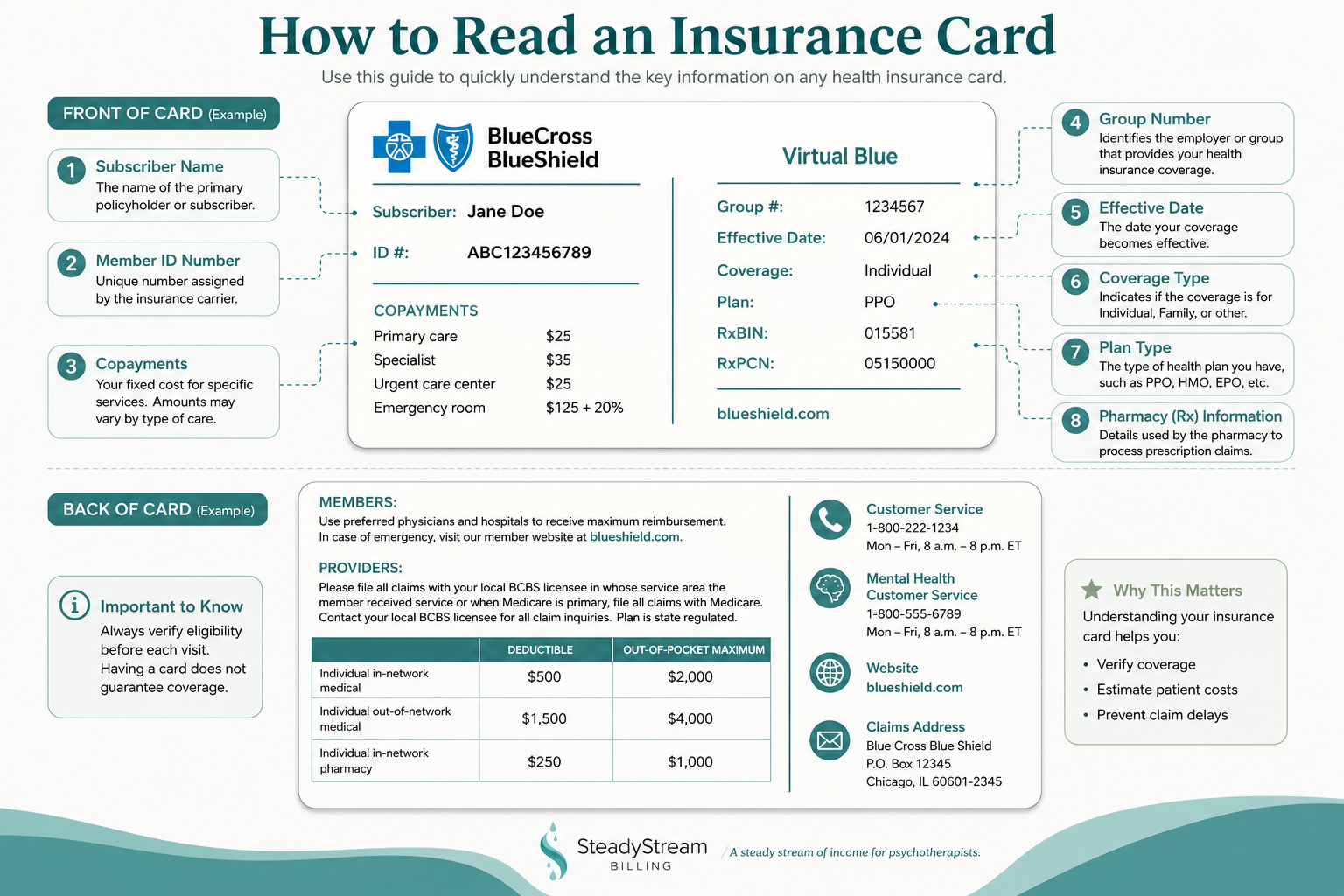
An infographic explaining how to read an insurance card, including where to find important details such as the member or subscriber ID, group number, plan type, insurance company information, member name, and copay or deductible information. The guide helps therapists understand which insurance card fields are needed for accurate eligibility checks and claim submission.
Image courtesy of ChatGPT (OpenAI, 2026).
Policyholder or Subscriber Name
The name on the card may belong to your client directly, but it may belong to the primary insurance subscriber. This is the person who holds the policy under which the client is covered, such as a parent or spouse (American Academy of Professional Coders [AAPC], 2025). Some cards list every covered family member by name. Others mark the relationship with an abbreviation like EMP (employee), SP (spouse), or CH (child) without listing individual names (AAPC, 2025).
The policyholder or subscriber name matters for claims because the name in your practice management software has to match the insurer’s records exactly. Even a small variation, like a missing middle initial or a maiden name versus a married name, can trigger a claim rejection.
Member ID / Policy Number
The Member ID or Policy Number uniquely identifies the covered individual to the insurance carrier, and it’s one of the most common sources of claim errors (AAPC, 2025). Every carrier formats it differently. Medicare, for example, issues an 11-character Medicare Beneficiary Identifier with no embedded meaning in the character sequence, while a carrier like Blue Cross Blue Shield commonly uses a prefix of letters followed by a string of numbers (Centers for Medicare & Medicaid Services, 2024). Because formats vary so widely, it’s worth double-checking this number character by character.
Copayment
A copayment or “copay” is a set dollar amount a client pays at the time of service, and cards frequently list several different copay amounts depending on the type of visit: primary care, specialist, urgent care, emergency room, and so on (AAPC, 2025). Mental health visits may be billed under the specialist rate, but this should always be confirmed since some plans list behavioral health separately with its own copay.
Coinsurance
Rather than a flat copay, some plans charge coinsurance: a percentage of the allowed amount that the client owes after meeting their deductible (if applicable). For example, if a plan has a 20% coinsurance and the allowed amount for a session is $160, the insurer pays $128 (80% of $160) and the client owes $32 (20% of $160).
Group Number
The group number identifies the specific employer-sponsored plan the client is enrolled in (if any). This is especially relevant for larger employers, which may offer several different plan variations under the same insurance carrier (AAPC, 2025). The group number tells the payer which specific plan rules apply to the claim (AAPC, 2025).
Plan Type or Type of Benefits
Insurance cards often note which categories of coverage the plan includes, such as medical, dental, vision, or behavioral health. For mental health billers, I recommend confirming that behavioral health coverage is either explicitly listed or verified beforehand with the payer. Some plans carve out mental health benefits to a separate managed care company with its own ID numbers and claims address.
Pharmacy (Rx) Copay Information
If the card includes pharmacy benefits, it will typically list copay tiers for prescriptions. For example, it may list a lower flat amount for generic drugs and a higher amount for brand-name medications. This section is generally more relevant to prescribing providers such as psychiatrists rather than non-prescribing psychotherapists.
Insurance Card Back: What Each Field Means
The back of the card usually contains deductible and out-of-pocket maximums, as well as the insurance company’s contact information, and it’s the section therapists and billers rely on most when investigating a claim rejection or denial (AAPC, 2025).
Deductible
The deductible is the amount a client must pay out of pocket for covered services before the insurance plan starts paying its share (AAPC, 2025). Some cards list the deductible amount directly, and others note that a deductible applies, in which case the exact figure and how much has already been met need to be confirmed with the payer. A client can’t be certain what they’ll owe for a session until checking the deductible. And a client who hasn’t met their deductible yet may be responsible for the full session fee.
The back of the insurance card often lists the following contact information for the insurance company:
Claims mailing address
Customer/member services phone number, intended for the policyholder to check their own benefits
Provider services phone number, which billers and practices should call, since these lines are staffed to handle claims and billing questions rather than general member inquiries
Hours of operation for the payer’s phone lines
Payer ID or EDI number, used to route electronic claims to the correct payer
A separate behavioral health contact, on some cards, if mental health benefits are managed by a different company than the client’s medical coverage
How to Verify Claim Information Against the Card
Before submitting a claim and immediately after a rejection or denial, compare these fields directly against the card:
Member ID number, matched character by character, including any letter prefixes or numeric suffixes
Subscriber and patient name, exactly as printed, including the correct relationship if the client is a dependent
Group number, particularly important for employer plans with multiple sub-plans
Payer ID, especially checking whether a behavioral health carve-out uses a different ID than the medical plan
Coverage status, since a card can be outdated even if it's the most recent one on file for that client
What To Do When a Mental Health Claim Is Rejected or Denied

Start with the card, not the phone. Line up the rejection or denial reason code against each data point on the card to look for an obvious mismatch.
Check for a behavioral health carve-out. A “subscriber not found” or “invalid payer” message often means the claim was billed to the medical payer ID instead of a separate mental health administrator.
Call the provider services line on the back of the card. This routes to reps who can address billing questions directly rather than the general member services line.
Confirm current information with the payer. If the insurance card appears outdated, contact the payer’s provider services or eligibility department to verify active coverage. Depending on the payer’s policies, the representative may be able to confirm updated eligibility details, including the member ID, group number, effective dates, and plan information. If the payer cannot release updated information to the provider, ask the client to provide their most current insurance card or call their insurance payer for updated information.
Correct the claim and resubmit, documenting whatever caused the original rejection or denial so the same error doesn’t repeat on future claims.
I recommend keeping copies of both the insurance card and a photo ID on file for every client to help resolve claim rejections or denials with less time and effort.

Making Card Collection Effortless for Clients
The easiest way to keep accurate, current card images on file is to make it simple for clients to submit their own. If your practice uses SimplePractice, clients can photograph and upload both sides of their insurance card directly through the Client Portal or the SimplePractice mobile app, without needing to bring a physical card to an appointment or email a scan separately (SimplePractice, 2026).
SimplePractice: Setting up insurance billing for your clients →
Prompting clients to upload their card at intake, and again any time their coverage changes, closes one of the most common and preventable gaps in mental health billing.
An insurance card holds nearly everything a therapist (and biller) needs to submit a clean claim and troubleshoot a denied one: the exact name and ID number the payer expects, the group number tied to the client’s plan, cost-share details like copays and deductibles, and direct contact numbers for the payer. Making it standard practice to collect, verify against, and reference the insurance card is a simple way to reduce claim problems and get paid faster.
References
American Academy of Professional Coders. (2025). The billing and collection process [Online course]. In Medical billing training: Certified professional biller ®. Coursera. https://www.coursera.org/learn/the-billing-and-collection-process/home/welcome
American Medical Billing Association. (2025). Mental health billing [Online course]. https://www.americanmedicalbillingassociation.com/mental-health-billing-course/
Centers for Medicare & Medicaid Services. (2024, September 10). Medicare beneficiary identifiers (MBIs). https://www.cms.gov/training-education/partner-outreach-resources/new-medicare-card/medical-beneficiary-identifiers-mbis
Griswold, B. C. (2025, February). Navigating the insurance maze: The therapist's complete guide to working with insurance – and whether you should (10th ed.). Barbara Griswold, LMFT, and Paper Street Press. https://theinsurancemaze.com/product/10thedition/
OpenAI. (2026). ChatGPT (July 13 version) [Large language model]. https://chat.openai.com/chat
SimplePractice (2026, January). Setting up insurance billing for your clients. https://support.simplepractice.com/hc/en-us/articles/360015456932-Setting-up-insurance-billing-for-your-clients
Educational Disclaimer
The information provided in this blog is intended for educational and informational purposes only and reflects general mental health billing guidelines and industry best practices available at the time of publication. SteadyStream Billing makes every reasonable effort to ensure the accuracy and reliability of the information presented; however, billing requirements, payer policies, regulations, and coding guidelines may change over time.
Readers are responsible for verifying current payer requirements, applicable regulations, and practice-specific guidelines before making billing, coding, or compliance decisions. SteadyStream Billing does not guarantee that the information provided is applicable to every individual practice, payer, or clinical situation.
This content is not intended to replace official payer guidance, legal advice, compliance consultation, or professional billing services. Providers remain responsible for ensuring their own compliance with applicable healthcare regulations and payer requirements.
Need Support With Your Mental Health Billing Process?
Billing doesn’t have to feel confusing, overwhelming, or disruptive to client care. At SteadyStream Billing, we partner with therapists to provide calm, consistent mental health billing services that support steady cash flow and strong client trust.
Whether you have questions about billing or are looking for ongoing billing support, we’re here to help.
Use the contact form below to ask a question or start a conversation about your practice’s billing needs.