Imagine you started therapy three months ago, and you’re starting to feel more comfortable and let your guard down. Then you check the mail and discover a $500 therapy bill and an explanation of benefits (EOB) from your insurance company. You learn your first month of appointments wasn’t covered by insurance because you owe a deductible first. You got a new job last summer and forgot your benefits had changed.
Because your therapist got behind on claims and submitted them close to the 90-day timely-filing deadline, you and the therapist may have been unaware of this deductible. Until now. But you don’t know that. You just feel blindsided and frustrated by this unexpected stress.
For therapy clients, financial surprises introduce uncertainty into a relationship being built on consistency and safety. Even if the issue stems from delayed claims or deductible confusion, clients often experience financial issues relationally, not administratively. Unwelcome surprises can lead to resentment, reduced openness, or even dropout.
While the client is also responsible for checking their benefits, proactive billing communication helps prevent these ruptures by reducing surprises and reinforcing trust and transparency. The first step to proactive billing communication is understanding the steps of the billing process, otherwise known as the “revenue cycle.”
What Is Revenue Cycle Management?
Revenue cycle management (RCM) is the healthcare industry’s term for the steps a provider takes to receive payment for services (Whitney, 2021).
Managing the revenue cycle well means:
collecting accurate information upfront,
communicating clearly about financial expectations,
submitting claims accurately and on time, and
addressing billing issues before they become bigger problems (American Academy of Professional Coders [AAPC], 2025).
For therapy practices, strong revenue cycle management protects therapist income and client care coverage by reducing billing confusion and preventing financial surprises. This transparency about finances helps maintain client trust, which in turn strengthens the therapeutic relationship and enhances your practice’s financial health.
The 8 Steps of the Revenue Cycle for Therapists
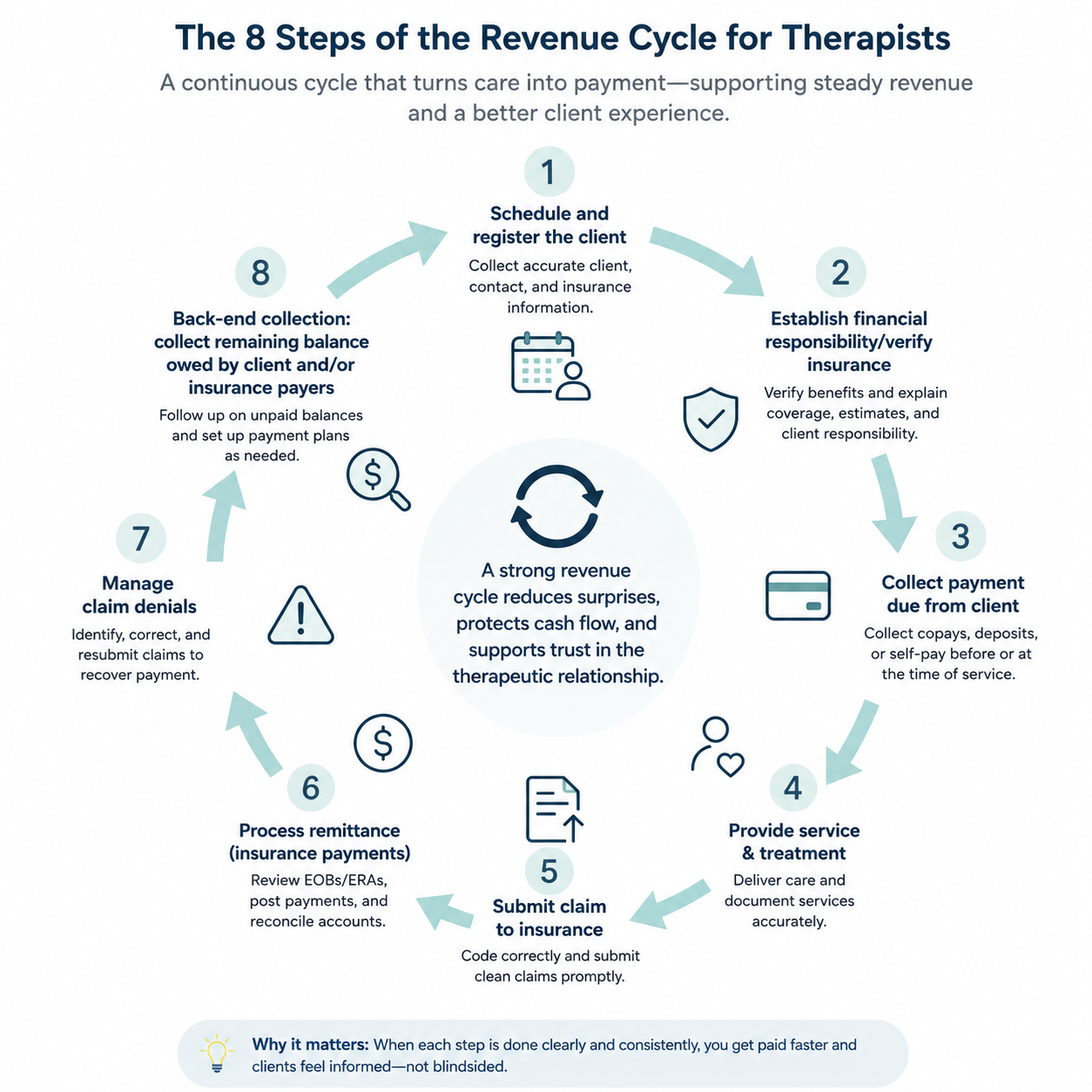
The 8-step revenue cycle shows how therapy practices move from scheduling a client to collecting final payment from insurance and patients. Each step supports timely payment, fewer billing errors, and a more transparent financial process for clients.
Schedule and register the client
Establish financial responsibility/verify insurance coverage
Collect payment due from client
Provide service and treatment
Submit claim to insurance
Process remittance (insurance payments)
Manage claim denials
Back-end collection: collect remaining balance owed by client and/or insurance payers
Image courtesy of ChatGPT (OpenAI, 2026)
The revenue cycle includes every step involved in receiving payment, from intake to final payment collection (AAPC, 2025).
I group these steps into three phases:
Before Care
During Care
After Care
In this post, we’re focusing on “Phase 1: Before Care.” This phase lays the foundation for clean billing and strong client relationships. Many billing problems can be traced back to breakdowns here, including claim denials, surprise balances, and payment disputes.
The steps you take before providing care set expectations early and help prevent future surprises. Clear systems at this stage create smoother billing and stronger trust.
Step 1: Schedule and Register the Client
This step begins the moment a prospective client books their first appointment and hands over demographic, contact, and insurance information. Gathering this information can feel like busywork, but it's the foundation of your entire revenue cycle. Imagine a client's birth date is off by one digit, or their member ID is transposed during intake. It seems minor, but even small errors can create major issues downstream:
misspelled names
incorrect birth dates
transposed member ID numbers
outdated insurance cards
These issues can result in claim rejections, delayed payments, and unnecessary follow-up work. Just as importantly, the onboarding experience shapes a client's first impression of your practice; a smooth, organized intake process helps clients feel safe and supported from the start.
Common Mental Health Billing Mistakes for Therapists to Avoid
Incomplete or incorrect insurance information, which can cause claim rejections and payment delays and lead to avoidable billing confusion later.
Disorganized intake workflow, which can lead to clients feeling uncertain or overwhelmed or weaken trust.
Step 2: Verify Insurance Coverage and Establish Financial Responsibility
This is one of the most important steps in the revenue cycle because if you get it wrong, every step after it inherits the problem. Its purpose is to clarify the following for both client and therapist:
whether the therapist is in-network or out-of-network with the client's insurance,
what insurance is expected to cover, and
what financial responsibility belongs to the client (AAPC, 2025).
The client’s financial responsibility may include the following:
copays,
deductibles,
coinsurance, and
authorization requirements (American Medical Billing Association [AMBA], 2025).
If a client is out-of-network or self-pay, this is the stage when therapists can explain payment expectations and superbill procedures (Griswold, 2025). If a client is in-network, verifying benefits helps estimate what insurance may cover and what the client may owe (Griswold, 2025).
The keyword here is estimate. Insurance verification does not guarantee payment by the insurance company; benefits can change, deductibles may apply unexpectedly, and the final determination happens only after the claim is processed (AAPC, 2025). Clearly communicating this and setting realistic expectations reduces unpleasant surprises for clients.
Clients should understand the following:
what coverage appears to be,
what their estimated cost may be, and
how initial estimates can change after claims are processed (AAPC, 2025).
Common Mental Health Billing Mistakes for Therapists to Avoid
Skipping eligibility verification, which can increase the risk of surprise balances and create confusion and distrust.
Presenting estimates as guarantees, which can result in clients feeling blindsided later and damage therapeutic trust.
Bonus Step 2b: Set Payment Expectations
Before care begins, clients should understand the therapist's payment policies and how billing works; the earlier this conversation happens, the less it costs you later.
This includes clarity around the following:
when invoices or superbills are sent,
when and how clients are charged,
when balances are due,
payment plans (if offered), and
who handles billing questions.
Setting expectations early may reduce stress later. When payment expectations are clear, financial conversations feel routine and manageable; when they're vague, confusion and discomfort build quietly until a billing issue surfaces and forces the conversation anyway. Proactive communication protects both revenue and the therapeutic alliance. Clients are far less likely to feel blindsided when they understand the process from the start.
Common Mental Health Billing Mistakes for Therapists to Avoid
Unclear payment policies, which can lead to confusion and billing disputes and make payment conversations more stressful.
Avoiding financial conversations, which allows uncertainty to build over time and increases the likelihood of breaks in trust.
Why “Phase 1: Before Care” Steps Matter
Strong front-end revenue cycle management creates clarity, reduces surprises, and helps clients feel safe entering treatment. When systems are proactive, organized, and transparent, billing becomes one less source of stress for therapists and clients alike; fewer surprises and smoother payments build stronger trust from the very beginning.
In Phase 2, we'll look at what happens during or shortly after care: documentation, coding, and claim submission.
References
American Academy of Professional Coders. (2025). The billing and collection process [Online course]. In Medical billing training: Certified professional biller ®. Coursera. https://www.coursera.org/learn/the-billing-and-collection-process/home/welcome
American Medical Billing Association. (2025). Mental Health Billing [Online course]. https://www.americanmedicalbillingassociation.com/mental-health-billing-course/
Griswold, B. C. (2025, February). Navigating the insurance maze: The therapist's complete guide to working with insurance – and whether you should (10th ed.). Barbara Griswold, LMFT, and Paper Street Press. https://theinsurancemaze.com/product/10thedition/
OpenAI. (2026). ChatGPT (June 26 version) [Large language model]. https://chat.openai.com/chat
Whitney, J. (2021, February 1). Simplify the revenue cycle management process: Part 1. AAPC. https://www.aapc.com/blog/55041-simplify-the-revenue-cycle-management-process/?srsltid=AfmBOorjRcIfxBR2-d8Bn7cFUG31_jbzSzKlaSCLjS8C2tfymjO9TEFo
Educational Disclaimer
The information provided in this blog is intended for educational and informational purposes only and reflects general mental health billing guidelines and industry best practices available at the time of publication. SteadyStream Billing makes every reasonable effort to ensure the accuracy and reliability of the information presented; however, billing requirements, payer policies, regulations, and coding guidelines may change over time.
Readers are responsible for verifying current payer requirements, applicable regulations, and practice-specific guidelines before making billing, coding, or compliance decisions. SteadyStream Billing does not guarantee that the information provided is applicable to every individual practice, payer, or clinical situation.
This content is not intended to replace official payer guidance, legal advice, compliance consultation, or professional billing services. Providers remain responsible for ensuring their own compliance with applicable healthcare regulations and payer requirements.
Need Support With Your Mental Health Billing Process?
Billing doesn’t have to feel disruptive to client care. At SteadyStream Billing, we partner with therapists to provide calm, consistent mental health billing services that support steady cash flow and strong client trust.
Whether you have questions about billing or are looking for ongoing billing support, we’re here to help.
Use the contact form below to ask a question or start a conversation about your practice’s billing needs.